Intergenerational Collaboration: Reporting Under Censorship and Threat
Lida Barez, Member of Booda Editorial Team

Note: This investigative article was originally developed in Farsi/Dari and has been translated into English.
***
The Taliban’s return to power plunged Afghanistan’s media into one of the most severe periods of repression in its recent history. Dozens of media outlets were shut down, hundreds of journalists lost their jobs, and the space for free information was systematically restricted. More than four years later, many Afghan journalists have not been silenced. Many continue to work clandestinely, often anonymously or under pseudonyms, while others collaborate with exile-based media.
Experienced journalists who were forced to leave the country after the fall of the Republic say that exile did not mean the end of their professional activity. What stands out in their accounts is not a complete halt to work, but a shift in roles and methods of collaboration in producing and publishing news. This transformation has taken on particular meaning through connections with the new generation of journalists still inside Afghanistan.
This report focuses on intergenerational collaboration and examines how the transfer of experience and professional support from exiled journalists to the younger generation inside the country has made it possible to sustain the profession under conditions of severe censorship and restrictions on freedom of expression.
Shegofa Danesh, a journalist and media activist with more than eight years of experience in mainstream Afghan media, says that after leaving the country, her professional role fundamentally changed. “My role shifted from being directly in the field to a supportive, analytical, and connecting one. My focus is now on passing on experience, amplifying the voices of journalists inside the country, and creating safe channels for those voices to reach the outside world.”
This shift reflects the extreme restrictions on independent journalism inside Afghanistan. According to the annual report of the Afghanistan Journalists Center, at least 205 cases of media freedom violations were recorded in 2025, including threats, arrests, and violence against journalists. These restrictions have transferred much of the responsibility for information dissemination to cross-border networks and exiled journalists.
Danesh emphasizes that this change has created a new kind of relationship with the younger generation of journalists, especially women, a relationship based more on trust and support than on mere news production. She says: “My main concern is no longer just producing reports; it is protecting journalists’ safety, building their professional capacity, and providing psychological and ethical support.” In her view, when female journalists face systematic exclusion and direct threats, this companionship is not only a professional choice but an ethical necessity for keeping information flowing.
Exiled journalists say that intergenerational collaboration has been less the result of planned institutional efforts and more a spontaneous response to the vacuum in Afghanistan’s media structure. Wahab Sidiqi, a journalism instructor and digital media expert, describes it this way: “These collaborations have mostly been spontaneous, but the crisis in Afghanistan has sometimes turned this choice into an ethical responsibility.”
Online training in digital security, professional ethics, context-sensitive reporting, media leadership, documenting human rights violations, and building support networks that connect journalists inside the country to international media and organizations have become key activities and decisions driven more by professional and human responsibility than by formal structures.
Despite its supportive and ethical value, this model of collaboration is not free of structural complexities. In practice, decisions about when, how, and whether to publish reports are mostly made outside the country, in the newsrooms of exile media, a situation that can concentrate media power abroad and weaken the agency of journalists inside Afghanistan. This potential imbalance, though justified under the banner of “protection and security,” creates a thin line between professional support and control over narratives-a line that remains a source of tension and reflection in post-Taliban Afghan journalism.
These complexities manifest in difficult daily decisions where journalist safety and the need to publish must be weighed simultaneously. Sidiqi says, “No report is worth risking a journalist’s life. If we feel a proposal could endanger someone, we stop it.” This principle has led to tough choices: altering reporting methods, using pseudonyms, delaying publication, or abandoning stories entirely.
A journalist with Zan Times says: “In many cases, we have prevented publication to protect a journalist’s life, but most of the time we were able to publish by changing names and identifiers.” These experiences show that withholding reports due to threats to local sources is not hypothetical; it is part of the daily reality of journalism related to Afghanistan.
Post-Taliban journalism in Afghanistan reveals a fundamental ethical conflict that almost all interviewees mentioned: the tension between telling the truth and ensuring survival. Sidiqi explains: “The younger generation is bolder and less cautious, while the older generation is more careful. But caution does not mean retreating from the truth; it means rethinking the timing and method of publication.” In this context, survival itself becomes a form of resistance—one that makes continued reporting limited and costly, yet enduring.
Journalism in the Shadow of Fear and Anonymity
Journalists still living in Afghanistan who collaborate with exile media experience journalism in crisis conditions, where professional decisions are made not primarily on editorial priorities but at the dangerous intersection of risk, survival, and responsibility. The report’s findings show that post-Republic journalists face simultaneous threats to their security, psychological pressure, and job instability.
Most work under pseudonyms, avoid in-person contact, and maintain limited, encrypted, and unstable communication with media outlets. While this allows them to continue professionally, the cost is that the full risk is transferred from the media organization to the individual journalist. One journalist inside the country collaborating with an exile media outlet says, “Every report is a risk. You don’t know if it will be your last. But if we don’t write, who will tell the truth?”
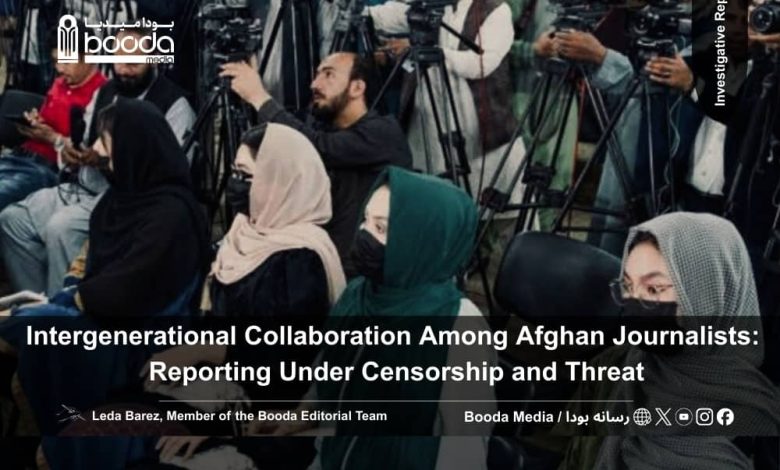
For women in particular, working from inside Afghanistan is not a free professional choice but an inevitable response to the complete closure of domestic media space. According to the Afghanistan Journalists Center, female journalists are barred from attending senior Taliban officials’ press conferences, and their voices are directly censored in domestic media. Aynoor Saidpour, who has worked with exile media for nearly two years, says: “To continue my journalistic mission of reflecting reality, especially in areas domestic media are not allowed to cover, I entered this path.” Zahra, another journalist from Afghanistan, cites the systematic exclusion of women and declining professional standards as the main reasons for this shift: “The censored environment and lack of real opportunities have structurally pushed us from domestic media to the outside.”
Despite differences in experience and focus, all interviewees agree on one point: continuing journalism is driven less by security or hope for the future and more by ethics and commitment. Basira Abdal expresses this commitment: “When I saw that many citizens’ voices had been silenced, I believed that silence causes no less harm than speaking the truth.” In addition to ethical motivation, economic pressure plays a significant role, blurring the line between professional choice and livelihood necessity in a context of widespread unemployment.
On the other hand, experienced exiled journalists serve a vital role as a network of professional and security support. This relationship goes beyond the traditional editor-reporter dynamic and functions as an informal protection mechanism. Lida, a journalist based in Kabul, says: “Knowing there is someone who understands both the risks and professional standards makes you feel less alone.” According to journalists, this support has, in many cases, directly reduced the risk of identity exposure, arrest, or harm to local sources.
Nevertheless, these mechanisms also involve difficult decisions. Many journalists have had to forgo publishing professionally valid reports because of high security risks. Shamsia from Balkh says: “In some cases, not writing was itself a professional choice.” This shows that censorship in Afghan journalism is not limited to direct political pressure; it is also reproduced through self-censorship and preemptive omission, where crisis/risk management replaces classic news values.
Working under pseudonyms, now a common practice, has consequences beyond identity protection. Analysis of interviews reveals erosion of professional capital. The 2025 annual report of the Afghanistan Journalists Center notes the closure of 20 television and 4 radio stations in the past year due to security and political reasons, emphasizing that the media environment has been systematically driven toward censorship and suffocation. Farhad Nezhad, a journalist using a pseudonym in Kabul, says: “Sometimes I decided to quit journalism because you have no name.” Yet many interviewees stress that prioritizing safety, impact, and the nature of the work over public recognition is necessary.
Collaboration between journalists inside Afghanistan and exile media is not a sustainable media model but an emergency solution to preserve narrative, a solution that shifts responsibility from institutions to individuals and turns journalism into a costly, silent, and exhausting act. Nevertheless, today’s anonymous and shadowy work remains one of the last pathways for recording collective memory and resisting the systematic erasure of reality in Afghanistan.
The Younger Generation and Incomplete Journalism Education
The experience of Maryam Ahmadi, a journalism student and reporter at Herat University, offers a clear picture of the younger generation, one whose formal university education has been interrupted by restrictions but who have found alternative paths to learning and professional activity. Maryam says, “I didn’t wait for universities to reopen. I returned to media work and learned journalism skills through short courses and online mentorship.”
She now collaborates with an international media outlet while continuing her journalism studies online, and credits the guidance of experienced journalists with playing a key role in her empowerment.
Redefining Journalism in Afghanistan
Journalists and media activists say that journalism in Afghanistan no longer fits its classical definition. Sidiqi states: “What is happening today is a combination of journalism, survival, and information resistance.” This view aligns with that of Zahra Joya, head of Rukhshana Media: “In a context where free flow of information has effectively been eliminated, continuing journalism, especially for women, is a form of resistance.” These statements underscore that sustaining information flow, even in limited and hidden forms, is a professional act of defiance aimed at documenting reality and preserving society’s collective memory.
The findings of this report show that journalists are striving to maintain a link between past professional experience and current reality. Joya emphasizes: “First, informing the public; second, training the new generation of journalists, especially women, because if we do not provide this training today, we may have no professional female journalists in ten years.” This perspective highlights that, in the absence of universities, free media, and supportive institutions, informal experience transfer and training have become one of the few mechanisms for sustaining journalism. Exile, in this sense, is not the end of a professional path but an opportunity to support, educate, and nurture a new generation of journalists.
Thus, the examination of intergenerational collaboration among Afghan journalists under Taliban censorship and the absence of freedom of expression reveals an informal yet vital form of organization—a structure built on ethical bonds, personal trust, and lived experience rather than on traditional media institutions. In such conditions, journalism in Afghanistan is no longer merely a profession; it is an act of survival, a soft struggle and enlightenment.
The persistent emphasis on security, the redefinition of roles, and the acceptance of limitations show that these intergenerational networks operate on the border between profession, ethics, and survival- a border whose absence would silence the free flow of information in Afghanistan.