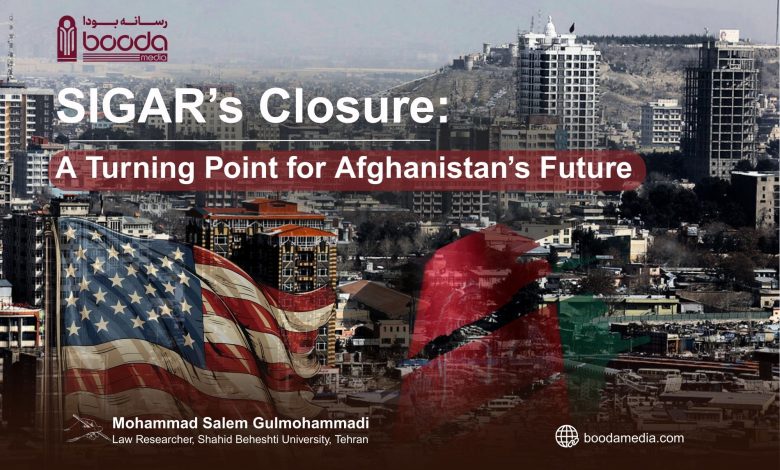
SIGAR’s Closure

The dissolution of the Office of the Special Inspector General for Afghanistan Reconstruction (SIGAR) on January 31, 2026, is far more than the simple closure of an administrative body; it marks a pivotal moment in Afghanistan’s relations with the international community, the structure of foreign aid, and the framework of accountability for two decades of intervention and reconstruction efforts.
The consequences of this development for Afghanistan’s future are multifaceted and interconnected, encompassing political, legal, economic, and historical dimensions.
Given that, this article examines the implications of SIGAR’s closure across several key areas.
- What Was SIGAR and Why Has It Ended?
SIGAR was established by the U.S. Congress in 2008 to oversee, audit, and investigate U.S. spending in Afghanistan—covering military, development, and humanitarian assistance. Between 2002 and mid-2021, it played a critical role in documenting waste, corruption, and misuse in reconstruction projects. Its quarterly reports to Congress and the public provided a relatively candid picture of the inefficiencies and corruption embedded in aid programs.
According to SIGAR’s final published reports, Congress allocated approximately $144–144.7 billion for Afghanistan’s reconstruction from 2002 to mid-2021—an amount some analysts compare to, or even exceed, major post-World War II reconstruction programs. In its closing statements, SIGAR emphasized that its mission had been to promote stability and democracy in Afghanistan, yet “in the end, it achieved neither.” This acknowledgment effectively admits the failure of the U.S.-led reconstruction and state-building project.
With direct U.S. aid to Afghanistan sharply reduced after the Taliban takeover and SIGAR itself recommending that oversight of remaining aid be transferred to the U.S. Agency for International Development (USAID), the decision to end the office on January 31, 2026 (corresponding to 11 Dalw 1404 in the Afghan calendar) was finalized by Congress.
- Political and Symbolic Implications for Afghanistan
The end of SIGAR is not merely an administrative decision; it represents an official admission of the failure of the U.S. reconstruction and state-building effort in Afghanistan. When an agency whose very purpose was to oversee reconstruction closes after 17 years—while Afghanistan still grapples with a crisis of political legitimacy, widespread poverty, and international isolation—the symbolic message is clear: the cycle of intervention, reconstruction, and withdrawal has concluded without delivering the promised outcomes.
Although U.S. physical presence ended in 2021, humanitarian aid and some indirect engagement channels have continued. SIGAR played an important ongoing role by warning about the risks of aid reaching the Taliban and highlighting flaws in distribution systems. For example, it noted that the United States remained Afghanistan’s largest donor after the withdrawal, providing roughly $3.8 billion, from which the Taliban also benefited.
With SIGAR’s dissolution, one of the primary channels for producing official, independent, and critical reports on the use of U.S. aid and its political and human-rights consequences disappears. This could lead to two main outcomes:
- Reduced structural pressure on the U.S. government to account for the consequences of its aid, as there will no longer be periodic, high-level audit reports submitted directly to Congress and the public.
- Loss of a vital information source for international organizations, human-rights bodies, and media outlets that relied on SIGAR’s findings to assess corruption, misuse, and the effectiveness of aid programs.
For the Taliban, the closure may symbolically signal the closing of a legal-political chapter tied to the U.S. presence. Some Taliban officials have argued that SIGAR never operated inside Afghanistan, only reviewed U.S. spending from afar, and became unnecessary after the troop withdrawal. This narrative seeks to limit responsibility to “U.S. presence and spending,” while many SIGAR findings also highlighted corruption within Afghan institutions and domestic networks.
- Legal and Historical Accountability Implications
Over 17 years, SIGAR produced a vast archive of documents, reports, and investigations covering development projects, security assistance, state-building strategies, and corruption networks. These records constitute an official written memory of the “war and reconstruction” period in Afghanistan and remain essential for any future transitional justice, truth-seeking, or policy analysis efforts.
With SIGAR’s dissolution, new report production ceases, and the focus shifts from active oversight to archival preservation. The office has stated that its website and digital content will be transferred to the U.S. federal government archives. This transition has two contrasting effects:
- It ensures the documents are preserved and remain accessible to researchers, journalists, and human-rights organizations.
- It confirms that no equivalent institution with comparable legal authority and resources will produce new reports unless a new mechanism is created.
For Afghanistan’s future, particularly regarding the public’s right to know how billions of dollars were spent and how corruption contributed to the previous system’s collapse, this creates a significant gap. SIGAR was the only official body with broad access and independent audit authority to pursue these issues.
SIGAR repeatedly demonstrated that tens of billions of dollars were wasted due to corruption, mismanagement, and flawed structures on both the American and Afghan sides. Yet genuine judicial accountability—at either the U.S. or Afghan level—remained limited, largely confined to political and media criticism. Without an alternative truth-seeking mechanism, SIGAR’s closure risks allowing many cases of corruption and abuse to fade into practical oblivion, surviving only in archived files.
This could have negative consequences for accountability culture both domestically and internationally:
- Domestically, it signals to former political elites that files can be closed without serious consequences, while deepening ordinary Afghans’ sense of injustice and futility regarding past exposures.
- Internationally, it reduces a key source of data and evidence for analyzing the relationship between military interventions, reconstruction, and violations of human rights and international humanitarian law—though existing documents can still be used in independent legal and truth-seeking processes.
- Economic Implications and the Future of Aid
In its final reports, SIGAR recommended that, starting in fiscal year 2026, USAID assume responsibility for overseeing U.S. aid to Afghanistan. This reflects the reduced scale of assistance and its shift from broad reconstruction to more targeted humanitarian and limited development aid.
The key difference is that SIGAR was an independent body with a mandate for critical auditing and direct reporting to Congress, whereas USAID has been an implementing agency with its own internal oversight structures but less independence and rigor.
Consequently, there is a risk of weaker, less transparent, and less critical oversight of remaining aid unless Congress establishes complementary mechanisms. For Afghanistan, this could mean:
- Less pressure to reform internal aid distribution mechanisms, especially under Taliban control and with limited media and civil-society access.
- Greater risk of aid becoming politicized—both domestically (used by the Taliban to consolidate power) and internationally (used by the U.S. as leverage without sufficient field-level monitoring).
Afghanistan remains heavily dependent on foreign aid, particularly for humanitarian needs, health, education, and basic infrastructure. SIGAR repeatedly showed how poor project design, lack of coordination with real needs, and structural corruption reduced aid effectiveness.
With SIGAR gone, an important institutional learning resource for avoiding past mistakes disappears unless international organizations, the United Nations, and the World Bank systematically incorporate its findings into future programming. If SIGAR’s lessons are marginalized, the same errors could be repeated in Afghanistan or elsewhere.
- Social-Psychological Implications and Collective Memory
Beyond oversight, SIGAR helped shape the Western “official narrative” of the war and reconstruction in Afghanistan. Media, researchers, and civil-society organizations frequently cited its reports as credible evidence of corruption, inefficiency, and the tension between political and development goals.
Its closure may gradually shift dominant narratives away from structural critique of the long international presence toward more immediate issues—humanitarian crisis under Taliban rule, migration, and security. These risks downplaying the historical responsibility of international actors and allowing simpler narratives that attribute the entire crisis to internal factors alone.
For Afghans and Afghan academics and civil society, a crucial task in coming years will be to preserve and critically engage SIGAR’s documentary legacy, integrating it into collective memory and education—particularly in law, political science, development, and peace studies.
SIGAR’s exposés, while valuable, also unintentionally deepened public cynicism about foreign aid effectiveness, as citizens saw billions spent yet poverty, unemployment, and insecurity persist. The loss of even this imperfect oversight mechanism may intensify that distrust.
If Afghanistan’s political trajectory eventually moves toward broader participation and renewed large-scale aid becomes necessary, eroded public trust will be a serious obstacle. Conversely, for the next generation of activists and journalists, SIGAR’s investigative legacy could inspire stronger domestic investigative journalism and oversight institutions—if political space and technical capacity allow.
- Opportunities and Threats for Afghanistan’s Future
In the absence of compensatory measures, SIGAR’s closure poses several major threats:
- Weakened formal accountability for past actions and greater practical impunity for those responsible.
- Potential conflicts of interest and reduced transparency in future aid, given that implementing agencies will now oversee themselves.
- Higher risk of repeating past mistakes if SIGAR’s findings are not actively used.
- Space for one-sided narratives that oversimplify Afghanistan’s complex crisis.
Yet, if managed wisely, the closure could also create opportunities. A future, more accountable Afghan political order could draw on SIGAR’s lessons to redesign relations with foreign aid—placing national ownership, transparency, and accountability at the center.
Preserved archives can enable universities, research centers, and civil-society organizations to produce balanced, evidence-based accounts of the past two decades and strengthen critical historical memory. SIGAR’s experience could also serve as a model for establishing strong national audit and anti-corruption institutions rooted in domestic will, separation of powers, and civil-society participation—though achieving this under current conditions appears extremely challenging.
Conclusion
The dissolution of SIGAR on January 31, 2026, can be seen as the “closing of the ledger” on a historical era: the U.S.-led military intervention and reconstruction effort that cost over $144 billion and carried profound human, political, and economic consequences. It symbolizes the failure of a state-building model based on top-down resource injection, reliance on narrow elites, and insufficient attention to social-political realities and structural corruption.
For Afghanistan’s future, the most significant implications appear at three levels:
- Politically and symbolically, the closure solidifies the narrative of failure and highlights the historical responsibility of foreign intervention, yet risks fading global public awareness of the crisis’s deeper roots.
- Legally and in terms of accountability, the absence of an independent oversight body makes justice and responsibility harder to pursue, increasing the chance that widespread past corruption will go unaddressed—unless alternative domestic or international mechanisms emerge.
- Economically and developmentally, shifting oversight architecture may reduce transparency and raise misuse risks, but serious application of SIGAR’s lessons could enable a redefinition of international cooperation based on transparency and national ownership.
The ultimate fate of SIGAR’s legacy in Afghanistan depends on whether the country’s academic, civil, and political communities—and the international community—transform this vast accumulation of data and experience into practical critical knowledge, or allow it to gather dust in archives and gradually fade from active political and legal memory. If the former path is chosen, SIGAR’s closure—despite its many threats—could become the starting point for deeper reflection on models of intervention, reconstruction, and state-building in Afghanistan and beyond.