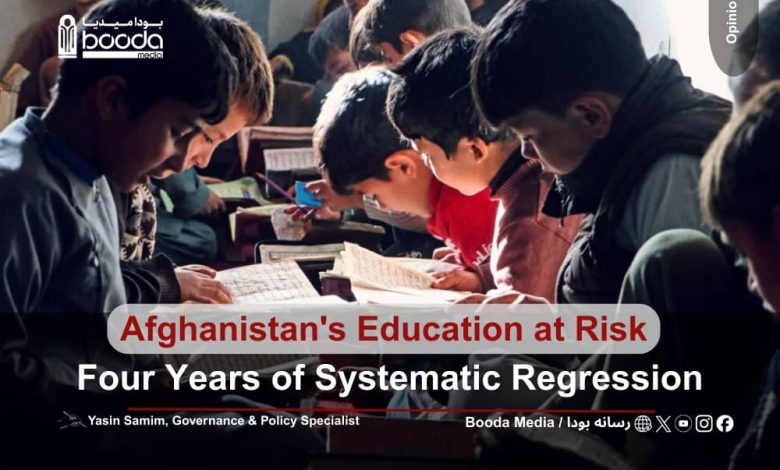
Afghanistan’s Education at Risk
Yasin Samim, MPA, MA, PMP, Former Director of Learning Assessment, MoE

Note: This article was originally developed in Farsi/Dari and later translated into English with some adjustments.
Introduction
From 2001 to 2021, under the Islamic Republic of Afghanistan, the education sector recorded historic progress. In 2001, under the first Taliban regime, girls were almost entirely excluded from schooling. By mid-2021, 3.8 million girls were enrolled, education up to grade 12 was available in government-controlled areas across all 34 provinces, more than 18,000 public and private schools were operational, and approximately 220,000 teachers, including 80,500 women, were employed. Textbooks were regularly revised and distributed. These achievements transformed opportunities for millions of Afghan girls and women in education, employment, and public life.
Since the Taliban regained power in August 2021, Afghanistan’s education system has suffered profound and systematic regression. Girls above grade six remain barred from secondary schools, and women are excluded from universities and most semi-higher education institutions. Female teachers and administrators face severe restrictions or dismissal. While international attention has largely centered on the ban on girls’ education, the crisis extends far beyond gender restrictions, affecting boys, curriculum quality, teaching standards, infrastructure, and the overall learning environment.
Drawing on recent reports from UNESCO, UNICEF, UN Women, Human Rights Watch, Rawadari, and other credible sources, this article examines seven critical dimensions of this regression as of early 2026.
1. Gender-Based Restrictions
Afghanistan remains the only country in the world that systematically prohibits girls from education beyond the primary level. In March 2022, the Taliban closed secondary schools to girls just hours before they were scheduled to reopen. In December 2022, they banned women from public and private universities and vocational institutions. [1]
According to the UNESCO-UNICEF Afghanistan Education Situation Report 2025, more than 2.2 million adolescent girls are deprived of secondary education.[2] UN Women’s 2024 Gender Index estimates that approximately 100,000 female university students have been excluded.[3] The UN Special Rapporteur on human rights in Afghanistan has characterized these policies as “gender apartheid” and warned of long-term economic losses exceeding $1 billion annually.[4] UNICEF has estimated that excluding girls from education reduces Afghanistan’s GDP by 2.5–5% per year and that continued education for the affected cohort could have generated at least $4.5–5.9 billion in economic benefits.[5]
The bans also indirectly harm boys’ education. With female teachers largely barred from boys’ schools, many have been replaced by unqualified individuals selected for ideological or tribal loyalty rather than pedagogical competence. [6] The Taliban cite Islamic law to justify restrictions, yet the Organization of Islamic Cooperation (OIC), prominent Muslim scholars, and multiple UN bodies have repeatedly stated that these policies contradict the broad Islamic consensus on mandatory education for both women and men. [7]
2. Ineffective Educational Management
The Taliban have systematically replaced qualified administrators and educators with loyalists, many of whom are graduates of jihadi madrasas with little or no formal training in education management. [8] The suspension of most international aid triggered by gender policies has drastically reduced the education budget, leading to irregular and low teacher salaries and benefits. [2]
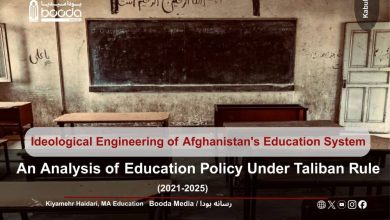
The UN 2025 report describes widespread disorganization, declining quality, and absence of effective oversight, with many schools lacking basic supplies such as blackboards, chalk, desks, and textbooks. [2]
3. Ideological Overhaul of the Curriculum
The curriculum has been radically altered without expert consultation. Subjects including foreign languages, chemistry, physics, social sciences, arts, sports, and civic education have been eliminated or sharply reduced. Religious instruction, rooted in Deobandi interpretations, has been significantly expanded. Textbooks aligned with the Ja’fari (Shia) school of thought have been banned, and new textbooks remain incompletely printed and distributed. [9] [10]
These secretive changes prioritize ideological conformity over critical thinking and modern skills, leaving students ill-prepared for contemporary labor markets.
4. Challenges Facing Teachers and Professional Staff
Teachers endure low and irregular salaries, virtually no professional development, and discriminatory treatment by Taliban-appointed managers. Mass dismissal of female teachers and their replacement with unqualified personnel has eroded the professional foundation built over two decades. [6] [11]
Reports document widespread abandonment of the profession and a reported 40% decline in boys’ high school enrollment. [11] [12]
5. Deteriorated Learning Environment
About 30% of schools lack safe drinking water, and 60% do not have proper sanitation facilities; many classes take place outdoors or in tents. [2] Strict dress codes, mandatory gender segregation, and intrusive age-verification practices have fostered a climate of fear, especially for girls in primary schools. [13]
Meanwhile, religious madrasas have proliferated, increasing from roughly 5,000–6,000 pre-2021 to an estimated 18,000–22,000 by 2025, enrolling approximately three million students. Reports of verbal abuse and corporal punishment in these institutions are common. [14][15]
6. Heightened Risk of Radicalization
Many former teacher-training institutes and public schools have adopted madrasa-style content and methods. The Taliban have established at least one large jihad-oriented madrasa in each of the 34 provinces, with a capacity for up to 1,000 students each. [15]
Religious studies scholar Mohammad Moheq describes the trend as “systematic brainwashing,” constituting an 80–100-year setback for education and women’s rights. He notes that the Taliban’s restrictive interpretations are outlier positions even within traditional Hanafi jurisprudence, primarily serving political control and obedience. [16]
7. Outdated Teaching Methods
Instruction remains predominantly rote and indoctrinatory. Laboratory work has been abandoned, critical thinking has been discouraged, and new “Emirate studies” examinations and competitions have been introduced. Documented practices include taking students to military sites and suicide-bomber graveyards, gender-based hate speech in textbooks, humiliating punishments, and physical violence. [6] [17]
These factors have heightened parental fears, contributing to declining enrollment for both girls and boys.
Conclusion
Over four years of Taliban rule have produced comprehensive regression across every facet of Afghanistan’s education system: discriminatory access, incompetent management, ideological curriculum, professional erosion, crumbling infrastructure, rising radicalization risks, and regressive pedagogy. Two decades of hard-won progress have been dismantled, pushing an entire generation toward poverty, mental health challenges, and extremism.
Reversing this crisis requires the immediate lifting of bans on girls’ and women’s education, the reinstatement of qualified professionals, a review of the scientific curriculum, regular salary payments, and sustained infrastructure investment. International advocacy must expand beyond a singular focus on girls’ education to address the full, systemic deterioration affecting all Afghan children.
References
[1] Human Rights Watch. (2023). Schools are Failing Boys Too: The Taliban’s Impact on Boys’ Education in Afghanistan. https://www.hrw.org/report/2023/12/06/schools-are-failing-boys-too/talibans-impact-boys-education-afghanistan
[2] UNESCO & UNICEF. (2025). Afghanistan Education Situation Report 2025. https://articles.unesco.org/sites/default/files/medias/fichiers/2025/10/Afghanistan%20Education%20Situation%20Report%202025.pdf (also available at https://www.unicef.org/afghanistan/documents/afghanistan-education-situation-report-2025)
[3] UN Women. (2024). Afghanistan Gender Index 2024. https://www.unwomen.org/sites/default/files/2025-06/gender-index-2024-afghanistan-en.pdf
[4] UN Special Rapporteur on the situation of human rights in Afghanistan (Richard Bennett). (2023). Report A/78/338. https://docs.un.org/en/a/78/338
[5] UNICEF. (2022–2025). Press releases and economic analyses on girls’ education (core data from 2022–2023, updated in later reports). Representative link: https://www.unicef.org/afghanistan/press-releases/afghanistans-education-system-facing-deepening-crisis-both-girls-and-boys-warn
[6] Human Rights Watch. (2023). Schools are Failing Boys Too (see [1]).
[7] Organization of Islamic Cooperation statements (2022–2024). links: https://www.oic-oci.org/topic?lan=en&t_id=33958&t_ref=22699
[8] UNESCO & UNICEF. (2025). Joint Situation Report (see [2]).
[9] Rawadari. (2024). Excluded and Deprived: The Educational Crisis for Women and Girls in Afghanistan. https://rawadari.org/wp-content/uploads/2025/01/RW_AccessToEducation_2024_Eng-1.pdf
[10] Human Rights Watch and UNICEF reports (2023–2025).
[11] Rawadari (2024) (see [9]).
[12] U.S. Institute of Peace. (2024). Publications on education and madrasa expansion. https://www.usip.org/publications/2024/05/talibans-attacks-diversity-undermine-afghanistans-stability
[13] Rawadari (2024) and field reports.
[14] Estimates drawn from UNESCO-UNICEF (2025) and USIP (2024).
[15] U.S. Institute of Peace (2024) and Etelaat Roz reporting.
[16] Interviews with Mohammad Moheq, published in Etelaat Roz (2024). Archives: https://www.etilaatroz.com/218632/(Dari).
[17] Human Rights Watch (2023) and Rawadari (2024).